How Strong Should You Be? Strength Standards for Every Stage of Lifting
“I’ve been lifting for about a year and I have no idea if I’m strong or just average — where should my squat, bench, and deadlift be at this point?”
After one year of consistent training with a structured programme, you should be able to squat around your bodyweight, bench press around 0.75× your bodyweight, and deadlift around 1.25× your bodyweight for a single rep. If you’re well below that, your programming is the likely culprit — not your genetics.
Here are realistic strength standards for every stage of lifting, what they assume, and why most people stall before reaching them.
Why strength standards exist
Strength standards give you a reference point. Without them, you have no way to know whether the progress you’re making is on pace or if something in your programming is holding you back.
They’re not targets to obsess over — genetics, bodyweight, age, and training history all affect where you land. But they are a useful diagnostic. If you’re two years in and your bench press is still below bodyweight, something is wrong: the programme, the progression model, the consistency, or all three.
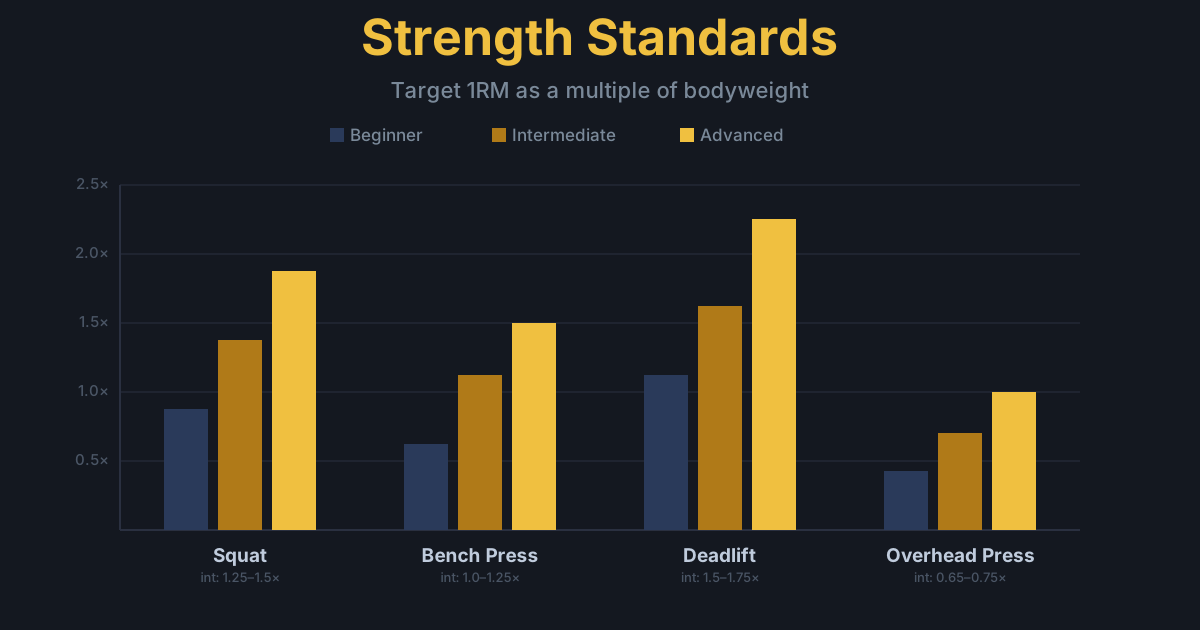
The standards below are based on 1-rep max (1RM) expressed as a multiple of bodyweight. This makes them applicable regardless of your size. A 70 kg lifter and a 100 kg lifter will have different absolute numbers — the ratios stay roughly consistent.
The four lifts that matter
These standards apply to the four compound barbell movements that most directly measure full-body strength development:
- Squat — lower body and total body strength
- Bench press — upper body pushing strength
- Deadlift — posterior chain and pulling strength
- Overhead press — shoulder and upper body pressing strength
If you train with dumbbells, machines, or bodyweight, these benchmarks don’t apply directly. They assume barbell training with proper technique.
Strength standards by training stage
Male standards (1RM as a multiple of bodyweight)
| Lift | Beginner (< 1 year) | Intermediate (1–3 years) | Advanced (3+ years) |
|---|---|---|---|
| Squat | 0.75–1.0× | 1.25–1.5× | 1.75–2.0× |
| Bench press | 0.5–0.75× | 1.0–1.25× | 1.5× |
| Deadlift | 1.0–1.25× | 1.5–1.75× | 2.0–2.5× |
| Overhead press | 0.35–0.5× | 0.65–0.75× | 1.0× |
Female standards (1RM as a multiple of bodyweight)
Women develop strength at the same relative rate as men but tend to express lower absolute numbers relative to bodyweight, particularly in upper body pressing. These benchmarks reflect that:
| Lift | Beginner (< 1 year) | Intermediate (1–3 years) | Advanced (3+ years) |
|---|---|---|---|
| Squat | 0.5–0.65× | 0.85–1.0× | 1.25–1.5× |
| Bench press | 0.35–0.5× | 0.65–0.75× | 1.0× |
| Deadlift | 0.65–0.85× | 1.0–1.25× | 1.5–1.75× |
| Overhead press | 0.25–0.35× | 0.45–0.5× | 0.65–0.75× |
Absolute examples at 80 kg bodyweight (male)
To make the numbers concrete: an 80 kg male lifter at the intermediate stage should be working toward roughly:
- Squat: 100–120 kg
- Bench press: 80–100 kg
- Deadlift: 120–140 kg
- Overhead press: 52–60 kg
These aren’t targets to hit in a single session — they’re working maxes that should be within reach after 1–3 years of structured, consistent training.
What “training age” actually means
These standards use training age, not calendar age. A year of consistent training — four sessions per week, structured programme, real progressive overload — produces dramatically different results than a year of sporadic gym visits with no clear plan.
If you’ve been going to the gym “for two years” but your attendance was inconsistent and you never followed a structured programme, your effective training age might be six months. The standards above assume:
- Consistent attendance — at least three sessions per week, week over week
- Structured programming — a plan that tells you what to lift and when to progress
- Real progressive overload — weights have been increasing systematically, not randomly
Most people who consider themselves intermediate lifters are functionally beginners by this definition. That’s not an insult — it’s a diagnosis. If the training hasn’t been structured and progressive, the clock starts when it becomes structured and progressive.
Why most people plateau before intermediate
The jump from beginner to intermediate standards is where most lifters stall. The reason is almost never genetics. It’s almost always one of three things:
1. They stopped tracking. You cannot apply progressive overload without knowing what you lifted last week. Lifters who stop tracking their sets and weights drift into comfortable repetition — the same weights, the same reps, forever. The body has no reason to adapt.
2. Their programme stopped adapting. Most beginner programmes — linear progression models — work extremely well for the first 6–12 months. After that, you can’t add weight to the bar every session. The programme needs to change: more sophisticated periodization, volume adjustments, exercise variation. Lifters who stay on their beginner programme past its useful life plateau because the programme has nothing left to give them.
3. They were never really progressing in the first place. A lot of programmes look like they’re applying progressive overload but aren’t. They add weight on a fixed schedule regardless of actual performance. If you missed half your reps in Week 4, Week 5’s weight increase is meaningless — you haven’t earned it. Progression has to come from your real logged data, not a calendar.
The solution to all three problems is the same: log everything, and use a programme that rebuilds from what you actually did last week, not from what you were supposed to do.
How to use these standards
Use these numbers as a diagnostic, not a scorecard.
If you’re ahead of the standard for your training age, you’re progressing well — keep the programming going and don’t change what’s working.
If you’re significantly behind, the question isn’t “am I weak?” — it’s “what in my programming isn’t working?” Usually the answer is one of the three failure modes above: no tracking, no adaptation, or false progression.
If you’re right at the standard, you’re on track. The gap to the next level is achievable with 12–18 months of continued structured training.
The overhead press is almost always the lagging lift. It develops slowly for everyone — being below standard on OHP while ahead on squat and deadlift is normal and not a concern.
The fastest path to intermediate
The lifters who reach intermediate standards fastest share one characteristic: they never guessed. Every session, they knew exactly what they lifted last time. Every week, the plan pushed them a little further than the week before. They didn’t program it themselves — they logged the data and let a system handle the progression.
That’s what an adaptive programme does. Not a static template that adds 2.5 kg on a schedule regardless of what happened — a plan that looks at your actual logged sets, your actual reps, and calculates next week’s targets from real data.
The standards above aren’t aspirational. They’re what consistent, progressive training produces. The only question is whether your current programme is actually delivering that progression — or just keeping you busy.
FAQ
How strong should I be after 1 year of lifting?
After one year of consistent, structured training, realistic targets are approximately a bodyweight squat (1.0×), 0.75× bodyweight bench press, 1.25× bodyweight deadlift, and 0.5× bodyweight overhead press for male lifters. Female lifters should target roughly 65–70% of those multiples. These assume genuine progressive overload — not just showing up and lifting by feel.
Are strength standards accurate, or are they just made up?
The bodyweight-multiple benchmarks used across the strength training community are derived from large datasets of trained lifters. They are not scientifically precise, but they are genuinely useful population-level reference points. Genetics, limb length, bodyweight, and training history all create individual variation — which is why the standards are presented as ranges, not single numbers.
How long does it take to reach intermediate strength standards?
Most lifters reach the intermediate range within 1–3 years of consistent, structured training. The timeline compresses significantly when programming is genuinely progressive — weights increasing every week based on real logged data — and expands when training is inconsistent or not actually applying progressive overload.
Is there a free app that tracks my strength progress toward these standards?
MuscleMind is free to download and includes the first week free with no subscription required. It logs every set, rep, and weight, and rebuilds your weekly plan from that data to apply progressive overload automatically. Hevy and Setgraph are also free for manual tracking if you prefer to manage your own programming.
How do strength standards compare between men and women?
Women develop relative strength at the same rate as men but tend to express lower numbers as a fraction of bodyweight, particularly in upper body pressing. Female intermediate standards are roughly 65–75% of male standards across the four main lifts. The deadlift gap is smallest; the overhead press and bench press gaps are largest.